 Panacea Bio ChemTechnical Preprint · Generative Protein Design
Panacea Bio ChemTechnical Preprint · Generative Protein Design
Panacea Bio ChemTechnical Preprint · Generative Protein Design
1Panacea Bio Chem Ltd, United Kingdom · correspondence via panaceabiochem.co.uk
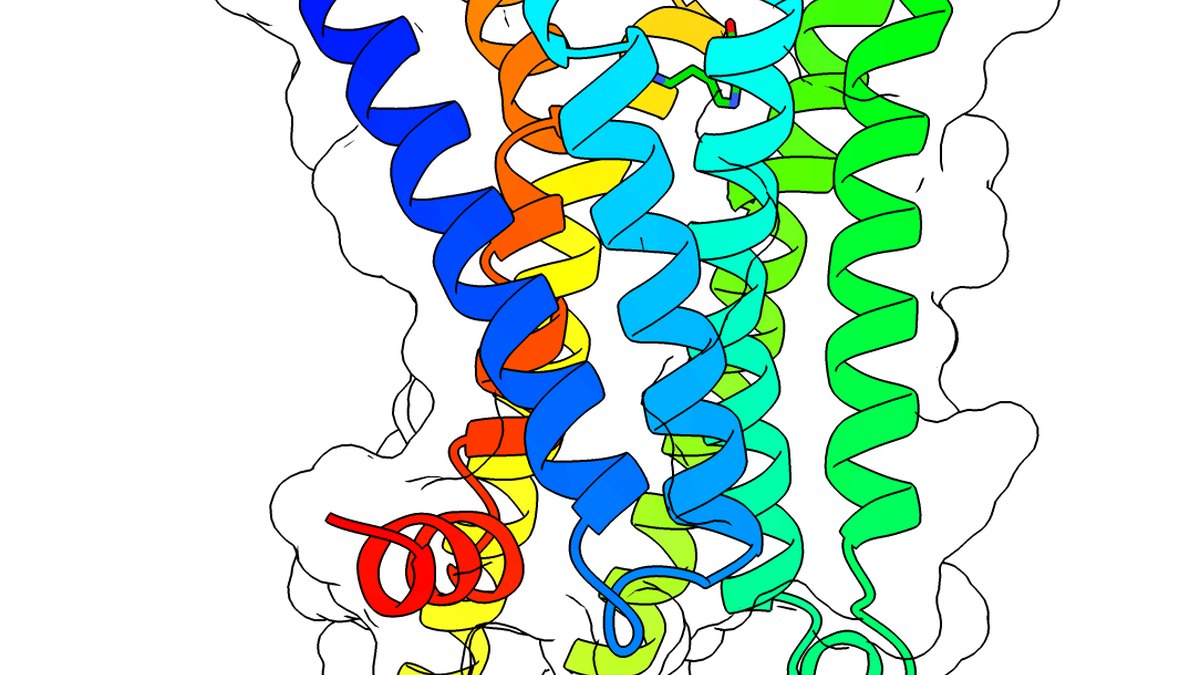
RFdiffusion — short for RoseTTAFold Diffusion — is a generative diffusion model5 for de novo protein design: it starts from random noise and denoises it, step by step, into a new, foldable protein backbone that corresponds to nothing in nature. Built by fine-tuning the RoseTTAFold structure-prediction network and paired with the ProteinMPNN2 sequence designer, it turns "I need a protein that does X" into a design brief a machine can answer — binders, enzymes, scaffolds and nanocages evolution never made. Yet designing a structure is only half the story. A designed, non-natural chain still has to be expressed, folded, dried, stored and reconstituted without falling apart — and that last mile, keeping a designed protein intact all the way to use, is the frontier Panacea Bio Chem works on.
Keywords: RFdiffusion · RoseTTAFold Diffusion · de novo protein design · generative protein design · diffusion model · ProteinMPNN · protein backbone generation · computational protein design
Every protein is a chain of amino acids that folds into a precise three-dimensional shape, and that shape decides what the protein does. For fifty years, the central problem was reading that shape: given a sequence, what does it fold into? Deep learning answered it. Alpha folding reads the fold of proteins that already exist →; RoseTTAFold, from the Baker lab, solved the same puzzle a different way4.
But reading nature's proteins is not the same as writing our own. RoseTTAFold Diffusion — usually shortened to RFdiffusion — turns the structure-prediction engine around. Instead of reading an existing protein, it generates entirely new ones1: shapes that obey every physical rule real proteins follow, yet exist in no genome and have no evolutionary history.
The distinction matters. Nature's proteins are the survivors of four billion years of accident — a vast but arbitrary sample of what could exist. De novo design steps off that map. It asks not "what did evolution leave behind?" but "what shape would do the job — and can we build it?" That is a new kind of question, and RFdiffusion is one of the first tools that can answer it.
RFdiffusion borrows the engine behind image-generating diffusion models5 — the same family that turns a text prompt into a picture. Those models are trained by taking real images, adding noise until they are pure static, and learning to reverse the process: static in, coherent picture out. RFdiffusion does the identical trick with protein structures. Train it to un-noise thousands of real protein backbones, and it learns the deep grammar of how a chain of amino acids is allowed to fold — then it can start from a fresh cloud of noise and denoise it into a backbone that has never existed but could. The rules are real; the protein is new.
The process runs backwards, from chaos to order:
De novo design opens doors natural proteins keep shut. But the field's centre of gravity is already shifting: the design half is getting solved faster than the make-it-real half. The table below is the fault line.
| Dimension | Reading nature's proteins | Writing de novo proteins |
|---|---|---|
| Core question | What does this sequence fold into? | What shape does the job — build it |
| Search space | Proteins evolution happened to make | The unexplored protein universe |
| Representative tool | AlphaFold · RoseTTAFold | RFdiffusion + ProteinMPNN |
| Output | A predicted structure | A novel binder, enzyme, scaffold or cage |
| Stability track record | Backed by natural selection | Often marginal — must be engineered |
| The open bottleneck | Largely solved | Express · fold · dry · store · deliver |
Novel folds can be marginally stable — easy to unpick during drying or storage. Sequences evolution never wrote fold by rules the natural-protein playbook, and natural stabilisers, only partly cover. A brilliant design that denatures in the vial is a brilliant design that never reaches anyone. Designing the structure is increasingly the easy half; keeping a designed structure intact into a usable form is the frontier.
That frontier — designed, non-natural chains rather than evolved ones — is precisely the ground Panacea Bio Chem works on. Panacea builds custom amino-acid chains to purpose and treats the last mile — keeping a designed shape intact from the synthesiser to the syringe — as the real problem. Its ongoing work explores proprietary methods aimed at exactly the failure modes above:
The exact chemistries, sequences, parameters and hardware that make these methods repeatable remain proprietary to Panacea Bio Chem — the outline is here; the recipe stays behind the door.
Panacea Bio Chem's specific proprietary contribution to the de novo / designed-protein sphere is held by Bogdan Dicoias and is being prepared for disclosure. The exact new advance — beyond the preservation work described above — will be stated here once the operator confirms the wording. Nothing on this page invents a claim on his behalf.
De novo design has a founding moment, and it predates diffusion models by twenty years. In 2003, before deep learning touched biology, the Baker lab set the Rosetta software an audacious task: design a protein with a fold found nowhere in nature, atom by atom, and see whether real chemistry would obey the blueprint3. They iterated between choosing a sequence and predicting the structure it would make, and converged on a 93-residue α/β protein they called Top7. When it was expressed, crystallised and its structure solved, Top7 matched the design to within 1.2 ångströms — and was extraordinarily stable. A shape that had never existed had been written on a computer and then made real, exactly as drawn.
That proof-of-principle became a field. Two decades later its architect, David Baker, shared the 2024 Nobel Prize in Chemistry for computational protein design6; RFdiffusion is the generative heir of the same lineage. From Top7's single hand-guided fold to a diffusion model that dreams up backbones on demand, the arc is one long answer to a single question: if we can read the language of proteins, can we write in it? The answer is now yes — and the next sentence is about keeping what we write alive.
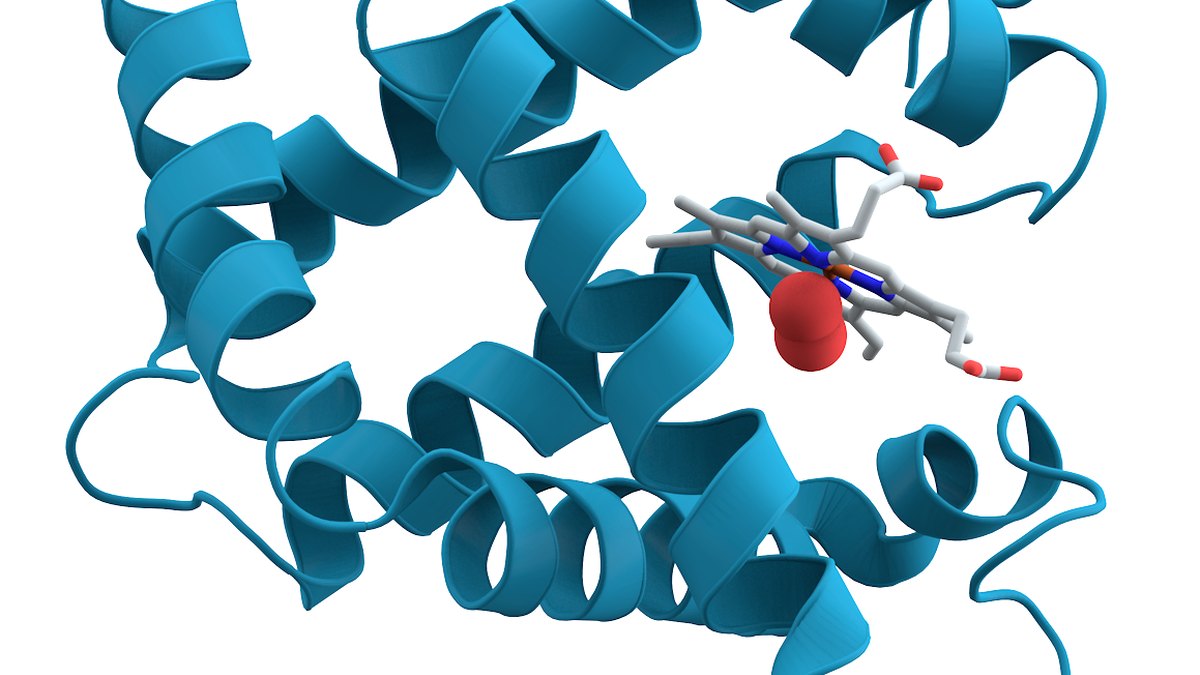
Designed proteins earn the most where nature left a gap — where no evolved molecule does quite what is needed:
Each of these shares one dependency the excitement often skips: the molecule has to survive synthesis, drying, storage and reconstitution still folded. That dependency is the thread tying generative design back to preservation — and to Panacea's work.
What is RFdiffusion?
RFdiffusion (RoseTTAFold Diffusion) is a
generative diffusion model for de novo protein design, built by
fine-tuning the RoseTTAFold structure-prediction network. It starts from random
noise and denoises it into a new, foldable protein backbone that exists nowhere
in nature. It was described by Watson and colleagues in Nature in 2023.
How is de novo protein design different from AlphaFold?
AlphaFold and
RoseTTAFold read structure — given a sequence, they predict its fold.
RFdiffusion writes structure — it generates new backbones built to perform
a task, then ProteinMPNN works out a sequence that folds into each one.
What can de novo designed proteins be used for?
Custom binders for
disease targets, de novo enzymes, vaccine and antigen scaffolds, symmetric
nanocages, biosensors and bespoke therapeutic peptides — functions reached by
design rather than by what evolution happened to make.
What is the hardest part of using a designed protein?
Making it real.
A designed, non-natural chain must be expressed, folded, dried, stored and
reconstituted without unfolding — and novel sequences sit outside the middle that
natural stabilisers handle well. Keeping a designed structure intact to the point
of use is the frontier Panacea Bio Chem works on.
Recent developments in the field — refreshed 2026-10-02 by Panacea Bio Chem.
The Panacea Technology Universe
Proprietary Panacea Bio Chem Ltd technologies, invented by Bogdan Dicoias — what each one does, and why it leads its class.
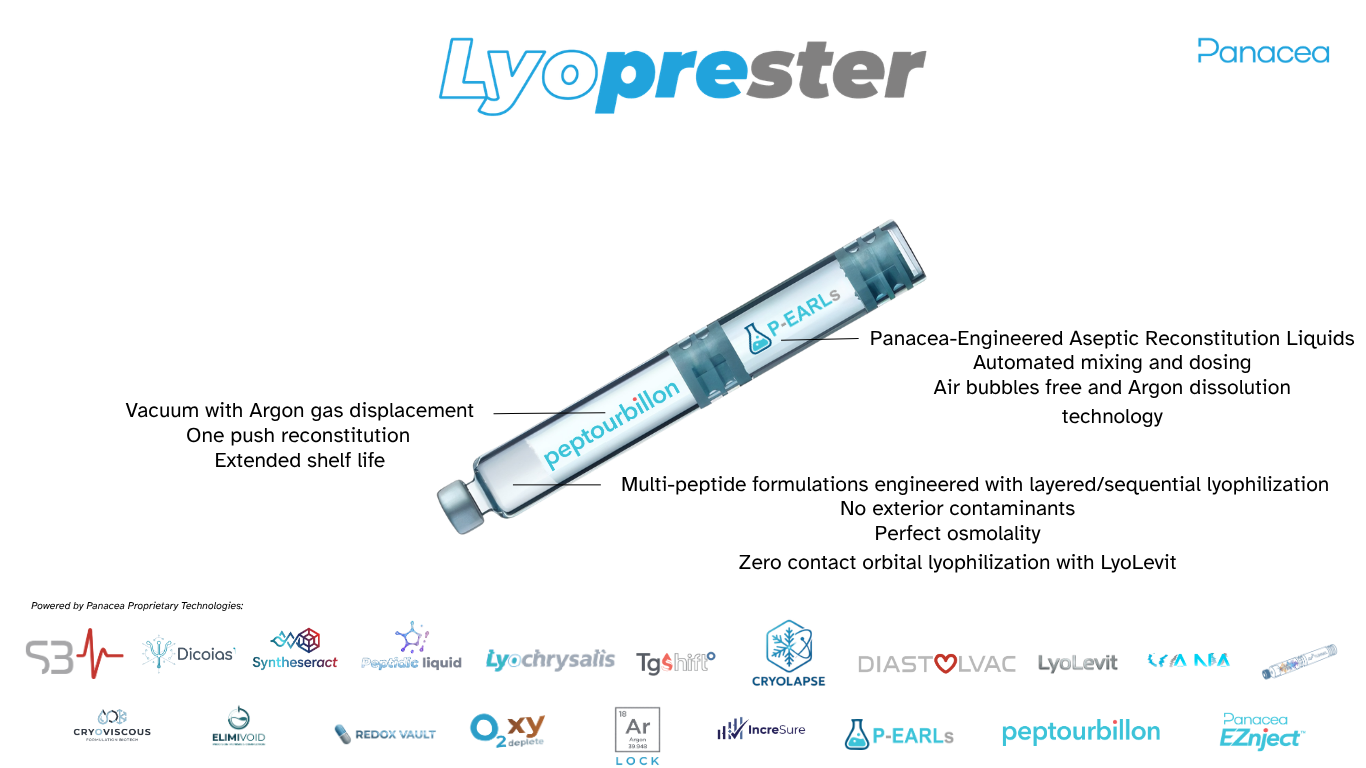
 Lyoprester®The only dual-chamber cartridge that is autoreconstitution-enabled, vacuum-sealed and argon-fillback.lyoprester.com ↗
 P-EARLs™Panacea-Engineered Aseptic Reconstitution Liquid(s) — each tuned to the peptide it wakes.p-earls.com ↗
 Peptourbillon™The layered peptide formulation architecture — single- or multi-layer, never a blend.peptourbillon.com ↗
 RF Tunnel™The RF-formed central channel through the cake.rftunnel.com ↗
 TgShift™Raises the cake’s glass-transition temperature with RF — instead of chilling below it.tgshift.com ↗
 Cryolapse™Cryogenic pressure collapse under S3Pulse™ control — vapour redistributed through the whole cake, not its surface, impeding crust formation.cryolapse.com ↗
 LyoLevit™The cake levitates and spins in high orbit — driven by ultrasound and RF.lyolevit.com ↗
 Lyochrysalis™The integrated chamber housing the whole drying stack.lyochrysalis.com ↗
 S3Pulse™The control brain for every piece of Panacea hardware.s3pulse.com ↗
 Liquiprester™The single-liquid cartridge engineered so multiple peptide APIs coexist in one shared vehicle.liquiprester.com ↗
 Syntheseract™Continuous-flow peptide synthesis in a special, very fast and economical way.syntheseract.com ↗
 CFSPPS™Continuous-flow solid-phase peptide synthesis, written as its own category.cfspps.com ↗
 OxyDeplete™Degassing plus no-headspace doctrine — the oxygen-starved seal.oxydeplete.com ↗
 ArgonLock™The final inert-atmosphere lock under argon.argonlock.com ↗
 RedoxVault™Separation, not merely suppression — redox isolation in lipid micro-reservoirs.redoxvault.com ↗
 PleniDose™The shared filling gantry — one machine filling both the dual-chamber Lyoprester and the liquid Liquiprester.plenidose.com ↗
 IncreSure™The dose-metrology layer — verified API per pen increment.incresure.com ↗
 ElimiVoid™Front-void elimination without touching the metered dose.elimivoid.com ↗
 Cryoviscous™The characterised cold, high-viscosity, low-mobility conditioning state.cryoviscous.com ↗
 Vana Machine™Vacuum–Argon–Nitrogen Architecture — draws the air and nitrogen out of the cake and backfills with argon; in a separate process, the same machine makes the P-EARLs bubble-free.www.vanamachine.com ↗
 EZnject™The disposable auto-injector pen built around the Lyoprester.panaceaeznject.com ↗
 Dicoias ΨThe computed-chemistry advisory — every substance reduced to a vector across physical, electronic and formulation space.dcppsi.com ↗
 SealoPrester™Aseptic Cartridge Closure System — Seal o’ Precision + Sterility.sealoprester.com ↗
 Peptidic LiquidThe peptide formulation in solution — the active plus its buffers, cryoprotectants, lyoprotectants and scaffolders.peptidicliquid.com ↗
 DiastolVAC™Biomimetic diastolic vacuum control — the pneumatic circulatory system of the machine: pumps, valves and sensors as one ensemble.diastolvac.com ↗
 KineticON™Motion Integrity Architecture — the motion-control layer that lets the machine know what happened on every axis move.kineticon.org ↗
Publications indexed in PubMed in the last 30 days for de novo protein design diffusion OR RFdiffusion protein — refreshed weekly.